
Understanding singular and plural nouns is a fundamental aspect of English grammar. It impacts sentence construction, subject-verb agreement, and overall clarity in communication.
This article provides a comprehensive guide to singular and plural nouns, covering definitions, rules, exceptions, common mistakes, and practice exercises. Whether you’re a beginner or an advanced learner, this resource will help you master the nuances of noun plurality and improve your English proficiency.
Table of Contents
- Introduction
- Definition of Singular and Plural Nouns
- Structural Breakdown
- Types and Categories of Plural Nouns
- Examples of Singular and Plural Nouns
- Usage Rules for Singular and Plural Nouns
- Common Mistakes with Singular and Plural Nouns
- Practice Exercises
- Advanced Topics in Noun Plurality
- Frequently Asked Questions (FAQ)
- Conclusion
Definition of Singular and Plural Nouns
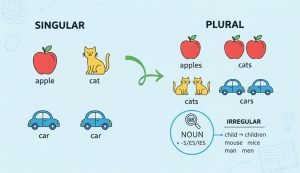
A noun is a word that represents a person, place, thing, or idea. Nouns are essential building blocks of sentences, acting as subjects, objects, complements, and more.
A singular noun refers to one person, place, thing, or idea. For example: cat, house, idea, John.
A plural noun refers to more than one person, place, thing, or idea. For example: cats, houses, ideas, Johns.
The primary function of plural nouns is to indicate quantity. They allow us to express whether we are talking about one entity or multiple entities.
When learning English grammar, it is equally important to consider plural and singular nouns in context. Observing how a singular noun transforms into its plural counterpart—and vice versa—helps avoid common mistakes in writing and speech.
Understanding the distinction between singular and plural nouns is crucial for grammatical accuracy and clear communication.
In summary, understanding a singular noun and plural noun is not just about counting; it involves recognizing how a noun’s number affects sentence structure, verb forms, and overall clarity. The distinction between singular vs plural nouns ensures that your writing is grammatically accurate and easily understood.
Structural Breakdown
The most common way to form a plural noun is by adding -s to the end of the singular noun. However, there are several other rules and exceptions that govern the formation of plural nouns in English.
- Regular Plurals: Adding -s or -es.
- Irregular Plurals: Nouns that don’t follow the standard rules.
- Nouns with Unchanging Forms: Nouns that have the same form in both singular and plural.
The specific rule that applies depends on the noun’s ending and its etymology (origin). For example, nouns ending in -s, -x, -ch, -sh, or -z usually require the addition of -es. Nouns ending in -y often change the -y to -i and add -es.
Types and Categories of Plural Nouns
Regular Nouns
Regular nouns form their plural by simply adding -s to the singular form. This is the most common type of plural formation in English.
Examples include: book – books, chair – chairs, table – tables, car – cars, pen – pens.
Nouns Ending in -s, -x, -ch, -sh, -z
Nouns ending in -s, -x, -ch, -sh, or -z typically form their plural by adding -es.
Examples include: bus – buses, box – boxes, church – churches, dish – dishes, buzz – buzzes.
Nouns Ending in -y
If a noun ends in a -y preceded by a consonant, the -y is changed to -i and -es is added. If the -y is preceded by a vowel, only -s is added.
Examples include: city – cities, baby – babies, story – stories, but day – days, boy – boys, key – keys.
Nouns Ending in -f or -fe
Many nouns ending in -f or -fe change the -f to -v and add -es. However, some simply add -s.
Examples include: leaf – leaves, wife – wives, knife – knives, but roof – roofs, cliff – cliffs, chief – chiefs.
Irregular Nouns
Irregular nouns do not follow the standard rules for pluralization. They have unique plural forms that must be memorized.
Examples include: man – men, woman – women, child – children, tooth – teeth, foot – feet, mouse – mice, person – people.
Nouns with Unchanging Forms
Some nouns have the same form in both singular and plural. These are often related to animals or collective nouns.
Examples include: sheep – sheep, deer – deer, fish – fish, species – species, aircraft – aircraft.
Latin and Greek Origin Nouns
Nouns of Latin or Greek origin often retain their original plural forms.
Examples include: radius – radii, alumnus – alumni, crisis – crises, phenomenon – phenomena, thesis – theses.
Compound Nouns
Compound nouns are nouns made up of two or more words. The plural is usually formed by adding -s to the main word.
Examples include: mother-in-law – mothers-in-law, passer-by – passers-by, toothbrush – toothbrushes, whiteboard – whiteboards.
Examples of Singular and Plural Nouns
The following tables provide examples of singular and plural nouns, categorized by the rules they follow.
Regular Nouns (Adding -s)
This table shows nouns that form their plural by simply adding an “-s” to the singular form. These are among the most common and straightforward examples of pluralization in English.
| Singular | Plural |
|---|---|
| Dog | Dogs |
| Cat | Cats |
| House | Houses |
| Tree | Trees |
| Flower | Flowers |
| Book | Books |
| Chair | Chairs |
| Table | Tables |
| Computer | Computers |
| Phone | Phones |
| Key | Keys |
| Door | Doors |
| Window | Windows |
| Car | Cars |
| Pen | Pens |
| Pencil | Pencils |
| Shirt | Shirts |
| Shoe | Shoes |
| Hat | Hats |
| Bag | Bags |
Nouns Ending in -s, -x, -ch, -sh, -z (Adding -es)
This table illustrates nouns that require the addition of “-es” to form their plural. This rule applies specifically to words ending in -s, -x, -ch, -sh, or -z to maintain pronunciation clarity.
| Singular | Plural |
|---|---|
| Bus | Buses |
| Box | Boxes |
| Church | Churches |
| Dish | Dishes |
| Buzz | Buzzes |
| Gas | Gases |
| Tax | Taxes |
| Match | Matches |
| Brush | Brushes |
| Quiz | Quizzes |
| Glass | Glasses |
| Fox | Foxes |
| Bench | Benches |
| Bush | Bushes |
| Fiz | Fizzes |
| Mass | Masses |
| Wax | Waxes |
| Lunch | Lunches |
| Flash | Flashes |
| Blitz | Blitzes |
Nouns Ending in -y (Changing -y to -i and Adding -es)
This table showcases nouns that end in “-y” preceded by a consonant. To form the plural, the “-y” is replaced with “-i” and then “-es” is added.
This rule is essential for correct spelling and pronunciation.
| Singular | Plural |
|---|---|
| City | Cities |
| Baby | Babies |
| Story | Stories |
| Family | Families |
| Party | Parties |
| Country | Countries |
| Library | Libraries |
| Factory | Factories |
| Army | Armies |
| Duty | Duties |
| Enemy | Enemies |
| Fly | Flies |
| Penny | Pennies |
| Poppy | Poppies |
| Salary | Salaries |
| Theory | Theories |
| Victory | Victories |
| Warranty | Warranties |
| Activity | Activities |
| Ability | Abilities |
Irregular Nouns
This table presents irregular nouns, which have unique plural forms that do not follow standard pluralization rules. These nouns require memorization, as their plural forms can be quite different from their singular forms.
| Singular | Plural |
|---|---|
| Man | Men |
| Woman | Women |
| Child | Children |
| Tooth | Teeth |
| Foot | Feet |
| Mouse | Mice |
| Person | People |
| Ox | Oxen |
| Goose | Geese |
| Louse | Lice |
| Datum | Data |
| Criterion | Criteria |
| Phenomenon | Phenomena |
| Addendum | Addenda |
| Curriculum | Curricula |
| Erratum | Errata |
| Memorandum | Memoranda |
| Formula | Formulae/Formulas |
| Vertex | Vertices/Vertexes |
| Index | Indices/Indexes |
Nouns with Unchanging Forms
This table lists nouns that have the same form in both singular and plural. These nouns do not change, regardless of whether they refer to one or multiple entities.
Context is crucial for understanding whether they are singular or plural.
| Singular | Plural |
|---|---|
| Sheep | Sheep |
| Deer | Deer |
| Fish | Fish |
| Species | Species |
| Aircraft | Aircraft |
| Salmon | Salmon |
| Trout | Trout |
| Cod | Cod |
| Offspring | Offspring |
| Headquarters | Headquarters |
| Gallows | Gallows |
| Means | Means |
| Works | Works |
| Crossroads | Crossroads |
| Series | Series |
| Swine | Swine |
| Corps | Corps |
| Pliers | Pliers |
| Scissors | Scissors |
| Innings | Innings |
Usage Rules for Singular and Plural Nouns
The correct usage of singular and plural nouns is essential for grammatical accuracy. Here are some key rules to follow:
- Subject-Verb Agreement: Singular subjects take singular verbs, and plural subjects take plural verbs. For example: The cat sleeps. The cats sleep.
- Pronoun Agreement: Pronouns must agree in number with the nouns they refer to. For example: The student finished his work. The students finished their work.
- Countable vs. Uncountable Nouns: Countable nouns can be singular or plural (e.g., apple, apples). Uncountable nouns usually do not have a plural form (e.g., water, information).
- Collective Nouns: Collective nouns refer to a group of individuals but can be treated as singular or plural depending on whether the group is considered a single unit or individual members. For example: The team is playing well. The team are arguing about their roles.
Understanding these rules and exceptions is crucial for constructing grammatically correct and clear sentences.
Common Mistakes with Singular and Plural Nouns
Many learners make common mistakes when dealing with singular and plural nouns. Here are some frequent errors and how to correct them:
- Incorrect Pluralization of Irregular Nouns:
- Incorrect: mans, childs, foots
- Correct: men, children, feet
- Misuse of Uncountable Nouns:
- Incorrect: informations, advices
- Correct: information, advice
- Incorrect Subject-Verb Agreement:
- Incorrect: The dogs is barking.
- Correct: The dogs are barking.
- Confusing Singular and Plural Forms:
- Incorrect: There is many people here.
- Correct: There are many people here.
By being aware of these common mistakes, you can avoid them and improve your accuracy in English.
Practice Exercises
Test your understanding of singular and plural nouns with the following exercises.
Exercise 1: Identify Singular and Plural Nouns
Identify whether the following nouns are singular or plural.
| Noun | Singular/Plural | Answer |
|---|---|---|
| Cats | Singular/Plural | Plural |
| Book | Singular/Plural | Singular |
| Children | Singular/Plural | Plural |
| House | Singular/Plural | Singular |
| Trees | Singular/Plural | Plural |
| Mouse | Singular/Plural | Singular |
| Women | Singular/Plural | Plural |
| Car | Singular/Plural | Singular |
| Dishes | Singular/Plural | Plural |
| Deer | Singular/Plural | Singular |
Exercise 2: Form the Plural Noun
Write the plural form of the following singular nouns.
| Singular Noun | Plural Noun | Answer |
|---|---|---|
| Box | Boxes | |
| Baby | Babies | |
| Leaf | Leaves | |
| Man | Men | |
| Fish | Fish | |
| City | Cities | |
| Tooth | Teeth | |
| Church | Churches | |
| Knife | Knives | |
| Child | Children |
Exercise 3: Fill in the Blanks
Fill in the blanks with the correct singular or plural form of the noun in parentheses.
| Sentence | Answer |
|---|---|
| There are many _______ in the park. (tree) | trees |
| The _______ is barking loudly. (dog) | dog |
| She has two _______. (child) | children |
| The _______ are on the table. (dish) | dishes |
| I saw a _______ in the forest. (deer) | deer |
| The _______ are flying south for the winter. (bird) | birds |
| He has a collection of rare _______. (stamp) | stamps |
| The baker made several delicious _______. (cake) | cakes |
| The library has many interesting _______. (book) | books |
| The farmer has a lot of _______. (sheep) | sheep |
Advanced Topics in Noun Plurality
For advanced learners, there are more complex aspects of noun plurality to explore:
- Pluralia Tantum: Nouns that only exist in the plural form (e.g., trousers, scissors).
- Singularia Tantum: Nouns that only exist in the singular form (e.g., furniture, information).
- The Use of “Number” with Plural Nouns: Understanding when to use “a number of” vs. “the number of.”
- Noun Phrases and Agreement: How noun phrases affect subject-verb agreement.
Delving into these advanced topics will further refine your understanding of English grammar and usage.
Frequently Asked Questions (FAQ)
What is the difference between countable and uncountable nouns?
Countable nouns can be counted and have both singular and plural forms (e.g., one book, two books). Uncountable nouns cannot be counted and typically do not have a plural form (e.g., water, sand). You can’t say “one water” or “two sands.” Instead, you quantify them using units of measurement like “a bottle of water” or “a grain of sand.”
How do I know when to use “is” or “are” with a collective noun?
If the collective noun is acting as a single unit, use “is.” If the members of the group are acting individually, use “are.” For example: The team is united. (single unit) vs. The team are disagreeing about the strategy. (individual members).
What are some common pluralia tantum nouns?
Common pluralia tantum nouns include: scissors, trousers, glasses, clothes, goods, stairs. These nouns are always used in the plural form, even when referring to a single item (e.g., a pair of scissors).
Why do some nouns have two possible plural forms?
Some nouns, especially those of Latin or Greek origin, may have two acceptable plural forms. One form is the original Latin/Greek plural, and the other is an English plural formed by adding -s or -es. For example: formula – formulas/formulae, index – indexes/indices. Usage often depends on context and preference.
How do I pluralize a compound noun?
Generally, you pluralize the main noun in a compound noun. For example: mother-in-law – mothers-in-law, passer-by – passers-by. However, if the compound noun is written as one word, simply add -s or -es (e.g., toothbrush – toothbrushes).
Are there any exceptions to the ‘-f’ to ‘-ves’ rule for pluralizing nouns ending in ‘f’ or ‘fe’?
Yes, there are several exceptions. Some nouns ending in ‘-f’ simply add ‘-s’ to form the plural, such as roof – roofs, cliff – cliffs, chief – chiefs, proof – proofs. The best way to learn these exceptions is through memorization and practice.
What is the correct plural form of “criterion”?
The correct plural form of “criterion” is “criteria.” “Criterion” is a singular noun, and “criteria” is its plural form. It’s important to use the correct form to maintain grammatical accuracy.
How do I know if a noun is singularia tantum?
Singularia tantum nouns are best learned through exposure and memorization. They often refer to abstract concepts, materials, or fields of study. Examples include advice, information, furniture, luggage, mathematics, physics. These nouns are always singular and do not have a plural form.
Conclusion
Mastering singular and plural nouns is crucial for effective communication in English. This article has covered the definitions, rules, exceptions, common mistakes, and advanced topics related to noun plurality.
By understanding these concepts and practicing regularly, you can improve your grammatical accuracy and fluency.
Remember to pay attention to subject-verb agreement, pronoun agreement, and the distinction between countable and uncountable nouns. With consistent effort and attention to detail, you can confidently navigate the complexities of English noun plurality.
Keep practicing and don’t be afraid to ask questions!