Choosing between “among” and “amoung” can be a common source of confusion for English language learners and even native speakers. While “among” is a frequently used and accepted preposition, “amoung” is simply a misspelling.
Understanding when and how to use “among” correctly is crucial for clear and effective communication. This article will delve into the definition, usage, common mistakes, and provide ample examples and practice exercises to help you master the correct usage of “among.” This guide is beneficial for students, writers, and anyone looking to refine their English grammar skills.
Table of Contents
- Definition of Among
- Structural Breakdown
- Usage Rules
- Examples of Among in Sentences
- Among vs. Between
- Common Mistakes
- Practice Exercises
- Advanced Topics
- Frequently Asked Questions
- Conclusion
Definition of Among
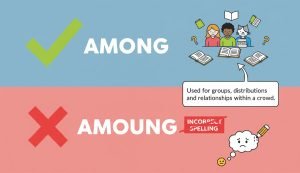
Among is a preposition that indicates being included or occurring within a group or collection of things or people. It suggests a sense of distribution or being surrounded by multiple entities. It is used to describe relationships where something is not isolated but rather a part of a larger whole. For instance, saying “She stood among the crowd” illustrates her presence as one individual within a larger group of people.
The word “among” implies that the items or individuals are not distinctly separated, but rather mixed or intertwined. It is often used when the exact number of items or individuals is not specified or is considered irrelevant.
The preposition serves to establish a context of shared space, characteristics, or circumstances. Consider “Happiness is found among friends,” where the emphasis is on the collective rather than any specific friendship.
Classification
As a preposition, “among” belongs to the class of words that connect nouns or pronouns to other words in a sentence, showing relationships of time, place, or manner. Prepositions are vital for structuring sentences and conveying meaning accurately.
“Among” specifically indicates a relationship of inclusion or distribution within a group.
Function
The primary function of “among” is to show the relationship between a subject and a group. It highlights that the subject is part of or surrounded by the group.
This preposition helps to provide context and clarify the position of the subject within a larger entity.
Contexts
The word “among” appears in various contexts, from everyday conversations to formal writing. It can be used to describe physical placement, emotional states, shared characteristics, or even abstract concepts.
Whether discussing a physical location like “among the trees” or an abstract idea like “among the possibilities,” the core meaning of inclusion within a group remains consistent.
Structural Breakdown
The structure of “among” is relatively simple, but its correct usage depends on understanding its role within a sentence. Typically, “among” is followed by a noun phrase, which can be a simple noun, a pronoun, or a more complex noun phrase with modifiers.
The noun phrase represents the group or collection that the subject is part of.
The placement of “among” in a sentence is usually before the noun phrase it modifies. This positioning helps to establish the relationship between the subject and the group early in the sentence.
For example, in the sentence “The book was hidden among the old papers,” “among” comes before “the old papers,” indicating where the book was located.
Here are a few structural patterns using “among”:
- Subject + Verb + Among + Noun Phrase: The child was lost among the crowd.
- There + Be + Subject + Among + Noun Phrase: There is peace among the nations.
- Adjective + Among + Noun Phrase: Happy among friends, she smiled.
Understanding these structural patterns can help you use “among” correctly in your own writing and speaking. It ensures that the relationship between the subject and the group is clear and unambiguous.
Usage Rules
Using “among” correctly involves understanding its specific function and context within a sentence. The general rule is that “among” is used when referring to three or more items or people.
This contrasts with “between,” which is typically used when referring to two items or people. However, there are exceptions and nuances to this rule.
Rule 1: Use “among” for three or more items or people. This is the most common and straightforward rule. For example, “The secret was shared among the siblings” (three or more siblings).
Rule 2: Use “among” when emphasizing a group as a whole. Even if there are only two items, “among” can be used if you are emphasizing that they are part of a larger, less defined group. This is less common but still grammatically correct. For example, “There was harmony among the couple and their friends” (emphasizing the larger social circle).
Rule 3: Consider the context. The context of the sentence can influence whether “among” or “between” is more appropriate. If you are highlighting the individual relationships between items, “between” might be better. If you are emphasizing the collective, “among” is usually the better choice.
Rule 4: “Amongst” vs “Among”. The word “amongst” is an archaic variant of “among”. While still technically correct, it is rarely used in modern English and can sound overly formal or affected. It’s generally best to stick to “among” in most situations.
Examples of Among in Sentences
To illustrate the correct usage of “among,” here are several examples categorized by different contexts.
Physical Location
The following table illustrates the usage of “among” to describe physical locations.
| Sentence | Explanation |
|---|---|
| The cabin was nestled among the trees. | Indicates the cabin’s location within a group of trees. |
| She searched for her keys among the clutter on the desk. | Describes the keys being located within a collection of items. |
| The wildflowers grew among the tall grass. | Shows the flowers’ placement within the grassy area. |
| The house stood proudly among the other buildings. | Highlights the house’s position within a group of structures. |
| He lost his phone among the crowd at the concert. | Indicates the phone was misplaced within a group of people. |
| The ancient ruins were hidden among the dense jungle. | Describes the ruins’ location within the jungle. |
| The small village was situated among the rolling hills. | Illustrates the village’s placement within the hills. |
| The treasure was buried among the rocks. | Indicates the treasure’s location within a group of rocks. |
| The restaurant is tucked away among the busy streets. | Describes the restaurant’s location within a group of streets. |
| The bird built its nest among the branches of the oak tree. | Shows the nest’s position within the tree’s branches. |
| The cat disappeared among the shadows. | Illustrates the cat’s location within the shadows. |
| The statue was placed among the other artifacts. | Indicates the statue’s location within a collection of artifacts. |
| The hiker found peace among the mountains. | Describes the hiker’s location within a group of mountains. |
| The child wandered among the rows of corn. | Shows the child’s placement within the cornfield. |
| The sheep grazed peacefully among the meadows. | Highlights the sheep’s position within the meadow. |
| The factory was situated among the industrial buildings. | Indicates the factory’s location within a group of buildings. |
| The lighthouse stood tall among the coastal cliffs. | Describes the lighthouse’s position within the cliffs. |
| The secret garden was hidden among the overgrown vines. | Illustrates the garden’s location within the vines. |
| The artist found inspiration among the bustling city. | Shows the artist’s placement within the city. |
| The old well was located among the farm buildings. | Indicates the well’s location within a group of buildings. |
Shared Characteristics
The following table illustrates the usage of “among” to describe shared characteristics.
| Sentence | Explanation |
|---|---|
| There was a sense of camaraderie among the team members. | Indicates a shared feeling of friendship within the team. |
| Honesty is highly valued among our employees. | Shows that honesty is a common trait among the employees. |
| There is a strong sense of loyalty among the soldiers. | Highlights the shared loyalty among the soldiers. |
| Kindness is prevalent among the volunteers. | Indicates that kindness is a common trait among the volunteers. |
| Intelligence is common among the students. | Shows that intelligence is a shared trait among the students. |
| Courage was evident among the firefighters. | Highlights the shared courage among the firefighters. |
| Creativity is fostered among the artists. | Indicates that creativity is a shared trait among the artists. |
| Respect is essential among the partners. | Shows that respect is a common value among the partners. |
| Trust is crucial among the friends. | Highlights the shared trust among the friends. |
| Patience is necessary among the teachers. | Indicates that patience is a common trait among the teachers. |
| Love was felt among the family members. | Shows that love is a shared emotion among the family. |
| Respect is essential among the colleagues. | Highlights the shared respect among the colleagues. |
| Understanding is important among the neighbors. | Indicates that understanding is a common trait among the neighbors. |
| Cooperation is vital among the workers. | Shows that cooperation is a shared trait among the workers. |
| Empathy is valued among the counselors. | Highlights the shared empathy among the counselors. |
| Dedication is evident among the nurses. | Indicates that dedication is a common trait among the nurses. |
| Integrity is expected among the leaders. | Shows that integrity is a shared value among the leaders. |
| Harmony is desired among the nations. | Highlights the shared desire for harmony among the nations. |
| Generosity is admired among the philanthropists. | Indicates that generosity is a common trait among the philanthropists. |
| Wisdom is respected among the elders. | Shows that wisdom is a shared trait among the elders. |
Distribution
The following table illustrates the usage of “among” to describe distribution.
| Sentence | Explanation |
|---|---|
| The money was divided among the heirs. | Indicates the money was distributed to multiple heirs. |
| Responsibilities were shared among the team. | Shows that the team members shared the responsibilities. |
| The tasks were allocated among the volunteers. | Indicates the tasks were distributed to multiple volunteers. |
| The food was distributed among the hungry. | Shows that the food was given to multiple people who were hungry. |
| The secrets were spread among the gossips. | Indicates the secrets were distributed to multiple gossips. |
| The information was disseminated among the public. | Shows that the information was distributed to multiple people. |
| The resources were allocated among the departments. | Indicates the resources were distributed to multiple departments. |
| The toys were divided among the children. | Shows that the toys were distributed to multiple children. |
| The work was shared among the colleagues. | Indicates the work was distributed to multiple colleagues. |
| The credit was given among the contributors. | Shows that the credit was distributed to multiple contributors. |
| The profits were divided among the shareholders. | Indicates the profits were distributed to multiple shareholders. |
| The lands were distributed among the farmers. | Shows that the lands were allocated to multiple farmers. |
| The awards were given among the winners. | Indicates that the awards were distributed to multiple winners. |
| The stories were shared among the friends. | Shows that the stories were distributed to multiple friends. |
| The knowledge was spread among the students. | Indicates that the knowledge was distributed to multiple students. |
| The power was divided among the branches of government. | Shows that the power was distributed to multiple branches. |
| The support was offered among the families. | Indicates that the support was distributed to multiple families. |
| The burdens were shared among the members. | Shows that the burdens were distributed to multiple members. |
| The responsibilities were delegated among the managers. | Indicates that the responsibilities were distributed to multiple managers. |
| The goods were distributed among the needy. | Shows that the goods were distributed to multiple needy people. |
Among vs. Between
The distinction between “among” and “between” is a common point of confusion. While “among” is used for three or more items, “between” is generally used for two.
However, there are more nuanced uses that depend on the context.
“Between” is used to show a relationship involving two distinct entities. It often highlights the individual connections or differences between these entities. For example, “The agreement was between the two companies” emphasizes the specific relationship between those two companies. “Between” can also be used when specifying each item in a group of three or more as distinct and individual. For example, “The negotiations between the US, China, and Russia were intense.”
“Among,” on the other hand, emphasizes the group as a whole, without necessarily highlighting individual relationships. For example, “There was peace among the nations” focuses on the collective harmony rather than specific bilateral relationships.
Here’s a table summarizing the key differences:
| Feature | Among | Between |
|---|---|---|
| Number of Items | Three or more (emphasizing the group) | Two (or more, individually considered) |
| Focus | Collective, group dynamic | Individual relationships, distinct entities |
| Example | The secret was shared among the siblings. | The agreement was between the two companies. |
Common Mistakes
One of the most common mistakes is misspelling “among” as “amoung.” “Amoung” is not a valid word in English. Always double-check your spelling to avoid this error.
For anyone wondering about the correct form, “among spelling” is straightforward: the word is spelled A-M-O-N-G. If you are asking, “how do you spell among,” remember this simple sequence to avoid the common error “amoung.” Comparing the two, “amoung vs among,” it’s clear that only “among” is correct. Keeping this spelling in mind helps ensure clarity and accuracy in both writing and formal communication.
Another common mistake is using “between” when “among” is more appropriate, or vice versa. Remember to consider whether you are emphasizing individual relationships or the group as a whole.
If you’re emphasizing the group, “among” is usually the correct choice.
Here are some examples of common mistakes and their corrections:
| Incorrect | Correct | Explanation |
|---|---|---|
| The treasure was hidden amoung the rocks. | The treasure was hidden among the rocks. | Corrects the misspelling of “among.” |
| The agreement was among the two parties. | The agreement was between the two parties. | Uses “between” for two distinct entities. |
| There was harmony between the nations. | There was harmony among the nations. | Uses “among” to emphasize the collective harmony. |
| The money was split between the heirs. | The money was split among the heirs. | Assumes three or more heirs, emphasizing distribution. |
Practice Exercises
Test your understanding of “among” with these practice exercises. Choose the correct word (“among” or “between”) for each sentence.
Exercise 1: Fill in the blanks with “among” or “between.”
| Question | Answer |
|---|---|
| 1. The decision was difficult to make ______ the various options. | among |
| 2. There is a strong bond ______ the siblings. | among |
| 3. The negotiations ______ the two countries were successful. | between |
| 4. The secret was kept ______ the three friends. | among |
| 5. The rivalry ______ the teams was intense. | between |
| 6. The prize was divided ______ the contestants. | among |
| 7. The discussion ______ the panelists was lively. | among |
| 8. The treaty ______ the nations brought peace. | between |
| 9. The tension ______ the characters was palpable. | between |
| 10. The support was shared ______ the community members. | among |
Exercise 2: Correct the sentences that use “among” or “between” incorrectly. If the sentence is correct, write “Correct.”
| Question | Answer |
|---|---|
| 1. The animosity among the two rivals was clear. | The animosity between the two rivals was clear. |
| 2. There was trust between the team members. | There was trust among the team members. |
| 3. The distribution was among the shareholders. | Correct |
| 4. The choice between the candidates was tough. | Correct |
| 5. The friendship among the pair was strong. | The friendship between the pair was strong. |
| 6. The agreement among the companies was signed. | The agreement between the companies was signed. |
| 7. The secret was shared between the three. | The secret was shared among the three. |
| 8. The competition between the athletes was fierce. | Correct |
| 9. The collaboration among the departments was effective. | Correct |
| 10. There was understanding between the neighbors. | There was understanding among the neighbors. |
Advanced Topics
For advanced learners, it’s important to understand the subtle nuances and idiomatic usages of “among.” One such nuance involves the use of “among” in more abstract or figurative contexts.
Consider the phrase “lost among the possibilities.” Here, “among” doesn’t refer to a physical location or a specific group of people, but rather to a range of options or potential outcomes. This usage extends the basic meaning of “among” to encompass abstract concepts and metaphorical relationships.
Another advanced topic is the use of “among” in formal or literary writing. While “amongst” is generally avoided in modern English, it may appear in older texts or in contexts where a more archaic tone is desired.
Understanding this historical usage can enhance your comprehension of classic literature and formal documents.
Additionally, advanced learners should be aware of the potential for ambiguity when using “among” in complex sentences. Clear and precise writing is essential to avoid any confusion about the intended meaning.
Pay close attention to sentence structure and context to ensure that the relationship being described is unambiguous.
Frequently Asked Questions
Here are some frequently asked questions about the usage of “among.”
Q1: Is “amoung” a real word?
A: No, “amoung” is a misspelling of “among.” Always use “among” when referring to inclusion within a group.
It’s important to clarify that “amoung definition” and “amoung meaning” do not exist because “amoung” is not a recognized English word. Any instance of “amoung” is simply a misspelling of “among.” Understanding this distinction ensures that learners searching for “amoung definition” or “amoung meaning” are guided back to the correct usage of “among,” which refers to inclusion within a group or collective.
Q2: When should I use “among” instead of “between”?
A: Use “among” when referring to three or more items or people and emphasizing the group as a whole. Use “between” when referring to two items or people, or when highlighting individual relationships between multiple distinct entities.
Q3: Is it ever correct to use “amongst”?
A: “Amongst” is an archaic variant of “among” and is technically correct but rarely used in modern English. It may appear in older texts or in contexts where a more formal or old-fashioned tone is desired.
Generally, it’s best to stick to “among.”
Q4: Can “among” be used with uncountable nouns?
A: Yes, “among” can be used with uncountable nouns when referring to a collection or range of things. For example, “There was confusion among the chaos.”
Q5: How can I avoid misusing “among” and “between”?
A: Pay close attention to the number of items or people being referred to and whether you are emphasizing individual relationships or the group as a whole. Practice using both words in different contexts to develop a better understanding of their nuances.
Q6: What is the difference between “amid” and “among”?
A: Both “amid” and “among” are prepositions that indicate being surrounded by something. “Amid” typically suggests being surrounded by something overwhelming or encompassing, often with a sense of being engulfed or immersed.
For example, “He stood amid the ruins.” “Among,” as discussed, indicates being a part of a group or collection of items or people.
Q7: Can “among” be used at the beginning of a sentence?
A: While less common, “among” can be used at the beginning of a sentence, particularly in more formal writing. For example, “Among the many challenges, they persevered.”
Q8: How does the use of “among” change in different dialects of English?
A: The core meaning and usage of “among” are generally consistent across different dialects of English. However, the frequency of use and stylistic preferences may vary.
For example, “amongst” might be slightly more common in certain British English contexts, although it is still generally less common than “among.”
Conclusion
Mastering the correct usage of “among” is essential for clear and effective communication in English. Remember that “among” is used to indicate inclusion or distribution within a group of three or more items or people, while “amoung” is simply a misspelling.
Pay attention to the context of your sentences and consider whether you are emphasizing individual relationships or the group as a whole to choose the correct preposition.
By understanding the definition, usage rules, and common mistakes associated with “among,” you can improve your grammar skills and write with greater confidence. Practice using “among” in various contexts and review the examples provided in this article to reinforce your understanding.
With consistent effort, you can confidently and accurately use “among” in your writing and speaking.