The word “should” is a versatile modal verb in English, serving a variety of functions from expressing obligation and advice to indicating probability and hypothetical situations. Understanding the proper should usage is essential for expressing advice, obligation, expectation, or regret correctly. By mastering the various uses of should in English, learners can ensure their statements convey the intended tone, whether offering polite recommendations, suggesting likely outcomes, or reflecting on past actions.
Recognizing these distinctions allows for more precise and effective communication in both formal and informal contexts. Understanding its nuances is crucial for both accurate comprehension and effective communication.
This article provides a comprehensive exploration of the different uses of “should,” equipping learners with the knowledge and practice necessary to master this essential aspect of English grammar. Whether you’re an ESL student, a seasoned writer looking to refine your skills, or simply curious about the intricacies of English, this guide will provide valuable insights and practical exercises to enhance your understanding of “should.”
Table of Contents
- Definition and Basic Function of ‘Should’
- Structural Breakdown of ‘Should’
- Types and Categories of ‘Should’
- Examples of ‘Should’ in Various Contexts
- Usage Rules of ‘Should’
- Common Mistakes with ‘Should’
- Practice Exercises
- Advanced Topics: Nuances and Complex Structures
- Frequently Asked Questions (FAQ)
- Conclusion
Definition and Basic Function of ‘Should’
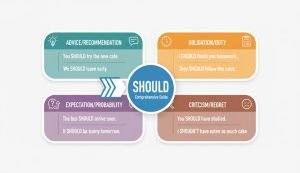
“Should” is a modal auxiliary verb, meaning it’s used with other verbs to express a particular mood or attitude. It doesn’t function as a main verb on its own. Its primary functions include expressing obligation, giving advice, indicating probability, forming conditional sentences, and expressing subjunctive moods. “Should” is often considered a milder or more polite version of “must” or “have to” when expressing obligation. It carries a sense of recommendation or expectation rather than a strict command.
The core function of “should” revolves around expressing what is considered the right or appropriate course of action, or what is likely to happen in a given situation. It adds a layer of subjectivity and judgment to the statement, suggesting a particular viewpoint or expectation.
This makes it a powerful tool for nuanced communication in various contexts.
Structural Breakdown of ‘Should’
The basic structure involving “should” is quite straightforward. It typically follows this pattern:
Subject + Should + Base Form of Verb
Here’s how it breaks down:
- Subject: The person or thing performing the action (e.g., I, you, he, she, it, we, they).
- Should: The modal verb indicating obligation, advice, probability, etc.
- Base Form of Verb: The infinitive form of the verb without “to” (e.g., go, eat, study, learn).
Examples:
- I should study for the exam.
- You should eat more vegetables.
- He should call his mother.
To form negative sentences, we insert “not” after “should”:
Subject + Should + Not + Base Form of Verb
Examples:
- I should not (shouldn’t) eat so much sugar.
- You should not (shouldn’t) be late.
- He should not (shouldn’t) worry so much.
For questions, we invert the subject and “should”:
Should + Subject + Base Form of Verb?
Examples:
- Should I call him?
- Should we leave now?
- Should they apologize?
Types and Categories of ‘Should’
“Should” can be categorized based on the specific function it performs in a sentence. Here are the main categories:
Should for Obligation and Advice
In this context, “should” expresses a sense of duty, recommendation, or a mild obligation. It’s often used to give advice or suggest a course of action that is considered beneficial or appropriate.
Example: You should see a doctor if you’re feeling unwell.
Should for Probability and Expectation
“Should” can also indicate a degree of probability or expectation. It suggests that something is likely to happen or be true based on the available information.
Example: The train should arrive in five minutes.
Should in Conditional Sentences
In conditional sentences, “should” can replace “if” in certain formal contexts, particularly when expressing a low probability or hypothetical situation. This usage often adds emphasis to the condition.
Example: Should you need any assistance, please don’t hesitate to contact us. (Formal equivalent of: If you should need any assistance…)
Should in Subjunctive Clauses
“Should” is used in subjunctive clauses after verbs expressing suggestion, recommendation, order, or request. It indicates that the action is desirable or important, even if it’s not certain to happen.
Example: The doctor recommended that he should exercise more.
Should for Expressing Regret or Criticism
“Should have” (should + have + past participle) is used to express regret about a past action or to criticize someone’s past behavior. It indicates that something different should have been done.
Example: I should have studied harder for the test.
Examples of ‘Should’ in Various Contexts
The following tables provide extensive examples of “should” used in different contexts, illustrating its versatility and range of meanings.
Table 1: Should for Obligation and Advice
This table demonstrates how ‘should’ is used to give advice, express recommendations, and indicate a mild sense of obligation.
| Example Sentence | Explanation |
|---|---|
| You should always brush your teeth before bed. | General advice for maintaining good hygiene. |
| She should try to be more patient with her children. | Recommendation for improving parenting skills. |
| He should apologize for his mistake. | Suggestion for resolving a conflict. |
| We should respect our elders. | Moral obligation to show respect. |
| They should arrive on time for the meeting. | Expectation and advice for professional conduct. |
| I should probably start exercising more. | Personal recommendation for health improvement. |
| You should consider all your options before making a decision. | Advice for careful consideration. |
| She should speak to her manager about the issue. | Suggestion for addressing a workplace problem. |
| He should listen to his doctor’s advice. | Recommendation for following medical guidance. |
| We should be grateful for what we have. | Moral obligation to appreciate blessings. |
| They should learn a new language. | Recommendation for personal growth. |
| I should spend more time with my family. | Personal desire and recommendation. |
| You should read that book; it’s excellent. | Enthusiastic recommendation. |
| She should take a vacation; she deserves it. | Suggestion for relaxation and reward. |
| He should save more money for the future. | Advice for financial security. |
| We should recycle to protect the environment. | Moral obligation for sustainability. |
| They should support their local businesses. | Recommendation for community support. |
| I should learn how to cook better. | Personal goal and recommendation. |
| You should visit the museum; it’s fascinating. | Enthusiastic suggestion for an activity. |
| She should call her grandmother. | Gentle reminder and recommendation. |
| He should be more responsible. | Advice for personal improvement. |
| We should appreciate the small things in life. | Philosophical advice for happiness. |
| They should volunteer in their community. | Recommendation for civic engagement. |
| I should wake up earlier. | Personal goal for productivity. |
| You should drink more water. | Health advice. |
Table 2: Should for Probability and Expectation
This table provides examples of how ‘should’ indicates what is likely to happen or be true based on current information or expectations.
| Example Sentence | Explanation |
|---|---|
| The movie should start in about 10 minutes. | Expected start time based on schedules. |
| She should be home by now. | Expectation based on her usual routine. |
| He should know the answer to that question. | Expectation based on his knowledge. |
| We should receive the package tomorrow. | Expected delivery date. |
| They should announce the results soon. | Expectation of an upcoming announcement. |
| The weather should be sunny this afternoon. | Forecasted weather condition. |
| She should pass the exam with flying colors. | High expectation of her success. |
| He should be able to fix the problem. | Confidence in his ability. |
| We should have enough food for everyone. | Expectation based on the amount of food available. |
| They should be finished with the project by Friday. | Expected completion date. |
| The store should be open until 9 PM. | Expected operating hours. |
| She should be fluent in Spanish after living there for a year. | Expected language proficiency. |
| He should understand the instructions clearly. | Expectation based on the clarity of instructions. |
| We should have a good time at the party. | Anticipation of an enjoyable experience. |
| They should agree with our proposal. | Expectation of acceptance. |
| The plants should grow well in this soil. | Expectation based on soil conditions. |
| She should be promoted soon. | Expectation based on her performance. |
| He should find a job quickly with his skills. | Expectation based on his qualifications. |
| We should see improvements in the economy next year. | Optimistic expectation of economic growth. |
| They should be happy with the results. | Anticipation of satisfaction. |
| The cake should be ready in 30 minutes. | Expected baking time. |
| She should be able to help you with that. | Confidence in her willingness and ability to assist. |
| He should remember to bring his passport. | Expectation based on the importance of the document. |
| We should hear back from them soon. | Anticipation of a response. |
| The flowers should bloom in the spring. | Expected seasonal occurrence. |
Table 3: Should in Conditional Sentences
This table showcases how ‘should’ can replace ‘if’ in formal conditional sentences, often emphasizing a low probability or hypothetical situation.
| Example Sentence | Explanation |
|---|---|
| Should you need anything, please call me. | Formal equivalent of “If you need anything…” |
| Should he arrive late, we will start without him. | Formal equivalent of “If he arrives late…” |
| Should it rain, the event will be moved indoors. | Formal equivalent of “If it rains…” |
| Should you change your mind, let us know. | Formal equivalent of “If you change your mind…” |
| Should they refuse to cooperate, we will take legal action. | Formal equivalent of “If they refuse to cooperate…” |
| Should you have any questions, feel free to ask. | Formal equivalent of “If you have any questions…” |
| Should she decide to join us, we’ll be happy. | Formal equivalent of “If she decides to join us…” |
| Should he fail the exam, he will have to retake it. | Formal equivalent of “If he fails the exam…” |
| Should we run out of supplies, we’ll need to go to the store. | Formal equivalent of “If we run out of supplies…” |
| Should they win the lottery, they would travel the world. | Hypothetical situation with low probability. |
| Should you find yourself in trouble, call the police. | Formal advice for a hypothetical situation. |
| Should she accept the offer, she’ll be moving to New York. | Conditional statement based on a decision. |
| Should he ask for help, offer it immediately. | Conditional instruction based on a request. |
| Should we encounter any problems, we’ll contact you. | Conditional assurance about communication. |
| Should they succeed, it will be a major achievement. | Conditional statement about a potential success. |
| Should you require further information, please visit our website. | Formal direction for obtaining more details. |
| Should she disagree, we will discuss the matter further. | Conditional statement about potential disagreement. |
| Should he forget his keys, he’ll be locked out. | Conditional consequence of forgetting something. |
| Should we lose the game, we’ll still be proud of our effort. | Conditional statement about potential loss. |
| Should they cancel the event, we’ll issue refunds. | Conditional action based on a cancellation. |
| Should you need to reschedule, please let us know in advance. | Polite instruction for rescheduling. |
| Should she choose to study abroad, she’ll gain valuable experience. | Conditional statement about the benefits of studying abroad. |
| Should he decide to retire, he’ll have more time for hobbies. | Conditional statement about retirement plans. |
| Should we decide to move, we’ll need to find a new house. | Conditional statement about the consequences of moving. |
| Should they choose to invest, they’ll need to research carefully. | Conditional advice about investing. |
Table 4: Should in Subjunctive Clauses
This table illustrates the use of ‘should’ in subjunctive clauses, typically after verbs expressing suggestion, recommendation, order, or request.
| Example Sentence | Explanation |
|---|---|
| The doctor recommended that he should stop smoking. | Recommendation for health reasons. |
| The teacher suggested that we should read more books. | Suggestion for improving literacy. |
| The manager ordered that all employees should attend the meeting. | Order for mandatory attendance. |
| I requested that she should call me back as soon as possible. | Urgent request for a return call. |
| It is essential that everyone should be aware of the safety procedures. | Emphasis on the importance of safety awareness. |
| The committee proposed that the project should be completed by next month. | Proposal with a deadline. |
| The law requires that all drivers should have insurance. | Legal requirement for insurance coverage. |
| It is crucial that the evidence should be preserved carefully. | Emphasis on the importance of preserving evidence. |
| The guidelines stipulate that all reports should be submitted on time. | Rule for timely report submissions. |
| My advisor insisted that I should take the advanced course. | Strong recommendation from an advisor. |
| It is important that you should understand the risks involved. | Highlighting the importance of understanding risks. |
| The company policy dictates that all employees should wear uniforms. | Mandatory uniform requirement. |
| It is recommended that you should consult with a financial advisor. | Professional recommendation for financial advice. |
| The instructions specify that the ingredients should be mixed thoroughly. | Detailed instruction for mixing ingredients. |
| It is advised that you should avoid contact with the infected area. | Medical advice for avoiding contact. |
| The contract states that all payments should be made within 30 days. | Contractual obligation for timely payments. |
| It is suggested that you should arrive early to avoid traffic. | Practical suggestion for avoiding traffic. |
| The regulations require that all vehicles should be inspected annually. | Mandatory annual vehicle inspection. |
| It is demanded that the hostages should be released immediately. | Urgent demand for the release of hostages. |
| The agreement specifies that both parties should adhere to the terms. | Contractual requirement for adhering to terms. |
| It is preferable that you should submit your application online. | Preferred method for application submission. |
| The university requires that all students should complete a thesis. | Academic requirement for completing a thesis. |
| It is requested that you should keep the noise level down. | Polite request for reducing noise. |
| The manual indicates that the device should be cleaned regularly. | Instruction for regular device maintenance. |
| It is critical that the system should be updated immediately. | Urgent need for system update. |
Table 5: Should for Expressing Regret or Criticism
This table focuses on the use of ‘should have’ to express regret about past actions or to criticize someone’s past behavior.
| Example Sentence | Explanation |
|---|---|
| I should have listened to my parents’ advice. | Regret about not following their advice. |
| You should have studied harder for the exam. | Criticism of past study habits. |
| He should have apologized for his behavior. | Criticism of his past actions. |
| We should have brought an umbrella; it’s raining now. | Regret about not preparing for the weather. |
| They should have arrived earlier to avoid the traffic. | Criticism of their tardiness. |
| I should have saved more money when I had the chance. | Regret about past financial decisions. |
| You should have told me about the problem sooner. | Criticism of withholding information. |
| He should have been more careful with the fragile items. | Criticism of his carelessness. |
| We should have booked the tickets in advance. | Regret about not planning ahead. |
| They should have considered the consequences of their actions. | Criticism of their lack of foresight. |
| I should have taken better care of my health. | Regret about past health habits. |
| You should have asked for help when you were struggling. | Criticism for not seeking assistance. |
| He should have been more respectful to his colleagues. | Criticism of his professional conduct. |
| We should have listened to the expert’s advice. | Regret about ignoring expert guidance. |
| They should have verified the information before sharing it. | Criticism of spreading misinformation. |
| I should have spent more time with my loved ones. | Regret about not prioritizing relationships. |
| You should have thought things through before making that decision. | Criticism of impulsive decision-making. |
| He should have prepared better for the presentation. | Criticism of inadequate preparation. |
| We should have checked the map before getting lost. | Regret about not using navigation tools. |
| They should have secured the building properly. | Criticism of security negligence. |
| I should have apologized immediately after the argument. | Regret about delayed apology. |
| You should have backed up your files before the computer crashed. | Criticism for not taking preventative measures. |
| He should have followed the safety guidelines more closely. | Criticism of neglecting safety procedures. |
| We should have invested in that company years ago! | Regret about a missed investment opportunity. |
| They should have addressed the issue before it escalated. | Criticism of not handling a problem promptly. |
Usage Rules of ‘Should’
Here are the key rules to remember when using “should”:
- Followed by the base form of the verb: “Should” is always followed by the base form of the verb (infinitive without “to”). For example: You should go. (Correct) vs. You should to go. (Incorrect).
- “Should not” or “Shouldn’t” for negation: To make a sentence negative, use “should not” or its contracted form “shouldn’t.” For example: You should not eat that. or You shouldn’t eat that.
- Inversion for questions: To form a question, invert “should” and the subject. For example: Should I leave now?
- “Should have” for past regrets/criticism: Use “should have” + past participle to express regret or criticism about a past action. For example: I should have studied harder.
- Formal conditionals: In formal writing, “should” can replace “if” at the beginning of a conditional clause. For example: Should you require assistance, please contact us.
- Subjunctive clauses: Use “should” in subjunctive clauses after verbs expressing suggestion, recommendation, order, or request. *Note:* In modern English, the “should” is often omitted in these clauses, especially in American English. For example: The doctor recommended that he should exercise more. or The doctor recommended that he exercise more.
Common Mistakes with ‘Should’
Here are some common errors to avoid when using “should”:
Mistake 1: Using “to” after “should”
- Incorrect: You should to go.
- Correct: You should go.
Mistake 2: Incorrect verb form after “should”
- Incorrect: He should went.
- Correct: He should go.
Mistake 3: Misusing “should of” instead of “should have”
- Incorrect: I should of known.
- Correct: I should have known.
Mistake 4: Confusing “should” with “would”
- Incorrect: If I had the money, I should buy a car.
- Correct: If I had the money, I would buy a car. (Expressing a hypothetical situation)
- Correct: I should buy a car. (If you are giving yourself advice.)
Mistake 5: Using “should” for strong obligation where “must” is more appropriate
- Less Strong: You should pay your taxes. (Implies less urgency)
- More Strong: You must pay your taxes. (Strong obligation with legal consequences)
Practice Exercises
Test your understanding of “should” with these exercises.
Exercise 1: Fill in the blanks with “should” or “shouldn’t” and the correct form of the verb in parentheses.
| Question | Answer |
|---|---|
| 1. You _______ (eat) so much junk food. It’s bad for you. | 1. You shouldn’t eat so much junk food. It’s bad for you. |
| 2. I _______ (study) for the exam, but I watched TV instead. | 2. I should have studied for the exam, but I watched TV instead. |
| 3. _______ I (call) her and apologize? | 3. Should I call her and apologize? |
| 4. She _______ (be) here by now. The meeting started 10 minutes ago. | 4. She should be here by now. The meeting started 10 minutes ago. |
| 5. They _______ (have) listened to my advice. Now they’re in trouble. | 5. They should have listened to my advice. Now they’re in trouble. |
| 6. He _______ (go) to the doctor if he’s feeling unwell. | 6. He should go to the doctor if he’s feeling unwell. |
| 7. We _______ (forget) to bring our passports. | 7. We shouldn’t forget to bring our passports. |
| 8. _______ you (need) any help, please let me know. | 8. Should you need any help, please let me know. |
| 9. The teacher recommended that we _______ (read) this book. | 9. The teacher recommended that we should read this book. |
| 10. I _______ (exercise) more often. | 10. I should exercise more often. |
Exercise 2: Rewrite the following sentences using “should have” to express regret.
| Question | Answer |
|---|---|
| 1. I didn’t save any money last year. | 1. I should have saved some money last year. |
| 2. You didn’t tell me you were having problems. | 2. You should have told me you were having problems. |
| 3. He didn’t study for the test, so he failed. | 3. He should have studied for the test. |
| 4. We didn’t bring a map, and now we’re lost. | 4. We should have brought a map. |
| 5. They didn’t listen to my warning. | 5. They should have listened to my warning. |
| 6. I ate too much cake at the party. | 6. I shouldn’t have eaten so much cake at the party. |
| 7. You didn’t lock the door. | 7. You should have locked the door. |
| 8. He didn’t apologize for his mistake. | 8. He should have apologized for his mistake. |
| 9. We didn’t check the weather forecast. | 9. We should have checked the weather forecast. |
| 10. They didn’t arrive on time. | 10. They should have arrived on time. |
Exercise 3: Rewrite the following “if” sentences using “should” in a formal style.
| Question | Answer |
|---|---|
| 1. If you need any assistance, please contact us. | 1. Should you need any assistance, please contact us. |
| 2. If he arrives late, we will start the meeting without him. | 2. Should he arrive late, we will start the meeting without him. |
| 3. If it rains, the picnic will be canceled. | 3. Should it rain, the picnic will be canceled. |
| 4. If you change your mind, please let me know. | 4. Should you change your mind, please let me know. |
| 5. If they refuse to cooperate, we will have to take further action. | 5. Should they refuse to cooperate, we will have to take further action. |
| 6. If you require more information, visit our website. | 6. Should you require more information, visit our website. |
| 7. If she decide to come, tell her to bring a friend. | 7. Should she decide to come, tell her to bring a friend. |
| 8. If he forget his keys, he won’t be able to get inside. | 8. Should he forget his keys, he won’t be able to get inside. |
| 9. If we run out of milk, I’ll go to the store. | 9. Should we run out of milk, I’ll go to the store. |
| 10. If they succeed in their mission, they will be rewarded. | 10. Should they succeed in their mission, they will be rewarded. |
Advanced Topics: Nuances and Complex Structures
For advanced learners, it’s important to understand some of the more subtle nuances of “should.” These include:
- Emphasis with “should”: Sometimes, “should” is used to express surprise or disbelief, adding emphasis to a statement. For example: “I was surprised to see him there. Who should I see but John!”
- “Should” with continuous tenses:“Should” can be used with continuous tenses (e.g., “should be doing”) to describe an action that is expected to be in progress at a particular time. For example: “By the time you arrive, I should be finishing dinner.”
- “Should” in reported speech: “Should” often remains unchanged in reported speech, even when the original verb is in the past tense. For example: “He said, ‘I should go home early.'” becomes “He said that he should go home early.”
- Subjunctive “should” in formal writing: In very formal or literary contexts, “should” can be used in subjunctive clauses to express a stronger sense of obligation or necessity. For example: “It is imperative that the truth should be known.”
Frequently Asked Questions (FAQ)
Q: What is the difference between “should” and “must”?
A: “Should” expresses a weaker obligation or recommendation, while “must” expresses a stronger, more imperative obligation. “Must” often implies a rule or law, while “should” suggests a moral or practical reason.
Q: Can “should” be used to make offers?
A: While “should” is not typically used for direct offers, it can be used in questions to soften a suggestion or seek advice. For example: “Should I bring a dessert to the party?” (asking for advice) vs. “Shall I bring a dessert to the party?” (making an offer).
A common question learners ask is, “Should you use ‘should’ in a particular situation?” Generally, should is appropriate when suggesting an action, indicating a mild obligation, or expressing probability. Understanding the context is key: for direct commands, must might be better; for polite advice or hypothetical situations, should fits perfectly. Considering these nuances helps in choosing when to use should effectively in speech and writing.
Q: Is it always necessary to use “should” in subjunctive clauses?
A: No, in modern English, the “should” is often omitted in subjunctive clauses, especially in American English. The sentence remains grammatically correct and conveys the same meaning. For example: “The doctor recommended that he exercise more.”
Q: What’s the difference between “should have” and “could have”?
A: “Should have” expresses regret or criticism about a past action, indicating that something different *should* have been done. “Could have” indicates a possibility or ability in the past, suggesting that something *could* have been done but wasn’t necessarily the best course of action.
Q: Can “should” be used with all subjects?
A: Yes, “should” can be used with all subjects (I, you, he, she, it, we, they) without any changes to its form.
Q: Is “should” more formal than “ought to”?
A: “Should” and “ought to” are often interchangeable, but “ought to” is generally considered slightly more formal or old-fashioned. In modern English, “should” is more commonly used.
Conclusion
“Should” is a multifaceted modal verb that plays a vital role in expressing various shades of meaning in English. From providing advice and indicating probability to forming conditional sentences and expressing regret, its versatility makes it an indispensable tool for effective communication.
By understanding its different uses, following the usage rules, and avoiding common mistakes, learners can master “should” and enhance their overall fluency and accuracy in English. Continued practice and exposure to diverse contexts will further solidify your understanding and enable you to use “should” with confidence and precision.