The terms “ok” and “okay” are ubiquitous in modern English, serving as versatile expressions of agreement, acknowledgment, or acceptance. While both are widely used and generally understood, subtle nuances and considerations for formal writing exist.
This article provides a comprehensive guide to understanding the origins, usage, and distinctions between “ok” and “okay,” equipping you with the knowledge to use them confidently and appropriately in various contexts. Whether you are an ESL learner, a student honing your writing skills, or simply someone interested in the intricacies of English grammar, this guide will clarify the proper usage of these common terms.
We’ll delve into the history of these words, examine their grammatical function, and provide numerous examples to illustrate their correct usage. We will also address common mistakes and offer practical exercises to reinforce your understanding.
By the end of this article, you will have a clear understanding of when to use “ok,” when to use “okay,” and how to avoid potential pitfalls.
Table of Contents
- Introduction
- Definition of “Ok” and “Okay”
- A Brief History
- Structural Breakdown
- Usage of “Ok” and “Okay”
- Examples
- Formal vs. Informal Usage
- Common Mistakes
- Practice Exercises
- Advanced Topics
- FAQ
- Conclusion
Definition of “Ok” and “Okay”
“Ok” and “okay” are terms used to express agreement, acknowledgment, acceptance, or to indicate that something is satisfactory or adequate. They function primarily as adjectives, adverbs, and interjections, depending on the context.
Both words are considered acceptable in most informal settings, but their usage can vary in formal writing.
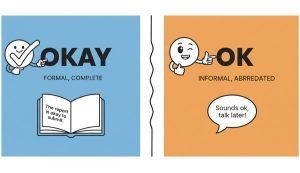
Many learners ask, “is it ok or okay?” or “ok or okay which is correct?” In most situations, both forms are acceptable, but context determines the better choice. In American English, “okay” is preferred in formal writing, while “ok” is more commonly used in casual conversation, emails, or messaging. Choosing the right form ensures your writing aligns with tone and audience expectations.
As an adjective, “ok” or “okay” describes something that is satisfactory or acceptable. For example, “The food was okay” or “The plan is ok with me.” As an adverb, it indicates that something is done in an acceptable manner. For example, “The report was completed okay.” As an interjection, it expresses agreement or understanding, similar to saying “yes” or “I understand.” For example, “Ok, I’ll do that” or “Okay, I understand your point.”
The terms are incredibly versatile, and their precise meaning is often determined by the tone of voice and the surrounding context. Understanding these nuances is crucial for effective communication.
A Brief History
The origin of “ok” is often attributed to a humorous fad in 1839, where abbreviations were used playfully. “Ok” purportedly stands for “oll korrect,” a deliberate misspelling of “all correct.” This playful abbreviation quickly gained popularity and spread through newspapers and other publications.
The longer form, “okay,” emerged later and is generally considered to be a variation of “ok.”
While the “oll korrect” theory is widely accepted, other theories exist, including suggestions that it originated from military jargon or other linguistic sources. Regardless of its precise origin, “ok” rapidly integrated into the English language and has become one of the most widely recognized and used words globally.
Its simplicity and versatility have contributed to its enduring popularity.
Structural Breakdown
Both “ok” and “okay” are relatively simple in structure. “Ok” consists of two letters, while “okay” consists of four.
Grammatically, they can function as adjectives, adverbs, and interjections, as previously mentioned. Their flexibility allows them to be easily incorporated into various sentence structures.
When used as an adjective, “ok” or “okay” typically precedes the noun it modifies. For example: “It’s an okay movie.” When used as an adverb, it usually modifies a verb.
For example: “The car runs okay.” As an interjection, it stands alone or begins a sentence. For example: “Okay, let’s go.”
The simplicity of these words belies their versatility and widespread use. Their adaptability to different grammatical roles makes them invaluable tools in everyday communication.
Understanding ok vs okay grammar
Although “ok” and “okay” are often used interchangeably, knowing the difference can refine your writing. “Okay” is more suitable in formal writing and works as an adjective, adverb, or interjection without sounding casual. “Ok” is acceptable in informal contexts and conversation but may appear abrupt in professional settings. Examples:
– Adjective: “The meeting went okay.” (formal: “okay” preferred)
– Interjection: “Ok, let’s start.” (informal: widely accepted)
– Adverb: “She completed the task okay.” (both forms work, though “okay” is safer in formal writing)
Understanding these distinctions addresses the common question: “what is the difference between ok and okay.”
Usage of “Ok” and “Okay”
Both “ok” and “okay” are generally interchangeable in most informal contexts. However, there are subtle differences and preferred usages depending on the situation.
Understanding these nuances can help you choose the most appropriate form for your communication.
Expressing Agreement
Both “ok” and “okay” can be used to express agreement with a statement or proposal. In this context, they signify that you agree with what has been said or suggested and are willing to proceed accordingly.
The choice between “ok” and “okay” is often a matter of personal preference or stylistic considerations.
Offering Acknowledgment
These terms are frequently used to acknowledge that you have heard and understood something. This usage doesn’t necessarily imply agreement but simply confirms that you have received and processed the information.
It’s a polite way to indicate that you are listening and following the conversation or instructions.
Indicating Acceptance
“Ok” and “okay” can also indicate acceptance of a condition, situation, or offer. This implies a more active agreement than mere acknowledgment, suggesting that you are willing to accept the terms or conditions presented.
This usage often involves a conscious decision to proceed based on the information provided.
As a Filler Word
Like “um” or “uh,” “ok” and “okay” can be used as filler words to give you time to think or to transition between thoughts. This usage is common in spoken language and is generally avoided in formal writing.
While it can be helpful in maintaining the flow of conversation, overuse can be distracting.
Examples
The following tables provide examples of “ok” and “okay” used in various contexts. These examples illustrate the different ways these terms can be used to express agreement, acknowledgment, acceptance, and as filler words.
Examples of “Ok” and “Okay” Expressing Agreement
The table below illustrates the use of “ok” and “okay” in expressing agreement within various conversational contexts. Notice how both terms effectively convey a sense of accord or willingness to proceed with a proposed action or idea.
| Sentence | Context |
|---|---|
| “Do you want to go to the movies tonight?” “Ok, sounds good.” | Responding to an invitation |
| “We need to finish this project by Friday.” “Okay, I’ll make sure it’s done.” | Agreeing to a deadline |
| “Let’s meet at the coffee shop at 3 PM.” “Ok, see you then.” | Confirming a meeting time |
| “Should we order pizza for dinner?” “Okay, that’s a great idea.” | Agreeing to a suggestion |
| “Can you help me with this problem?” “Ok, I’ll see what I can do.” | Agreeing to provide assistance |
| “We need to start the meeting now.” “Okay, let’s begin.” | Agreeing to start a meeting |
| “Do you want to try this new restaurant?” “Ok, I’m up for it.” | Agreeing to try something new |
| “I think we should take a break.” “Okay, good idea.” | Agreeing to take a break |
| “Let’s go for a walk.” “Ok, I need some fresh air.” | Agreeing to go for a walk |
| “We should probably leave now.” “Okay, let’s get going.” | Agreeing to leave |
| “Is it okay if I borrow your pen?” “Ok, no problem.” | Granting permission |
| “Do you understand the instructions?” “Okay, I think so.” | Confirming understanding |
| “We can start with chapter one.” “Ok, sounds like a plan.” | Agreeing to a starting point |
| “How about we work on this together?” “Okay, that would be helpful.” | Agreeing to collaborate |
| “Shall we review the proposal?” “Ok, let’s do it.” | Agreeing to review something |
| “Can you send me the document?” “Okay, I’ll send it right away.” | Agreeing to send a document |
| “Do you agree with my assessment?” “Ok, I see your point.” | Acknowledging agreement with an assessment |
| “So, we’re all in agreement?” “Okay, yes.” | Confirming overall agreement |
| “Let’s finalize the details tomorrow.” “Ok, I’ll be ready.” | Agreeing to finalize details |
| “Are you happy with the outcome?” “Okay, I am satisfied.” | Expressing satisfaction and agreement |
| “Do you want me to drive?” “Ok, thanks.” | Accepting an offer to drive |
| “Should we order more supplies?” “Okay, we’re running low.” | Agreeing to order supplies |
| “Let’s try a different approach.” “Ok, I’m open to suggestions.” | Agreeing to a different approach |
Examples of “Ok” and “Okay” Offering Acknowledgment
This table demonstrates how “ok” and “okay” are used to acknowledge information or instructions without necessarily implying agreement. These responses simply indicate that the message has been received and understood.
| Sentence | Context |
|---|---|
| “The meeting has been moved to 2 PM.” “Ok, I’ll be there.” | Acknowledging a change in schedule |
| “Please submit your report by Monday.” “Okay, I will.” | Acknowledging a deadline |
| “Remember to bring your ID.” “Ok, got it.” | Acknowledging a reminder |
| “The password has been reset.” “Okay, thanks for letting me know.” | Acknowledging information about a password reset |
| “The system will be down for maintenance tonight.” “Ok, I’ll plan accordingly.” | Acknowledging a system maintenance notice |
| “I’ve sent you the file.” “Okay, I received it.” | Acknowledging receipt of a file |
| “The instructions are on the screen.” “Ok, I see them.” | Acknowledging the location of instructions |
| “Please confirm your attendance.” “Okay, I confirm.” | Acknowledging a request for confirmation |
| “The door will be locked after 6 PM.” “Ok, I’ll keep that in mind.” | Acknowledging a security measure |
| “Don’t forget to sign the document.” “Okay, I won’t forget.” | Acknowledging a reminder to sign a document |
| “The train is delayed by 30 minutes.” “Ok, I’ll wait.” | Acknowledging a train delay |
| “Your appointment is scheduled for next Tuesday.” “Okay, I have it on my calendar.” | Acknowledging an appointment schedule |
| “The new policy goes into effect next month.” “Ok, I’ll review it.” | Acknowledging a new policy |
| “The server will be restarted in 5 minutes.” “Okay, thanks for the warning.” | Acknowledging a server restart warning |
| “The meeting room has been changed.” “Ok, I’ll go to the new location.” | Acknowledging a change in meeting room |
| “You need to update your software.” “Okay, I’ll do that later.” | Acknowledging a software update requirement |
| “Please read the terms and conditions.” “Ok, I will.” | Acknowledging a request to read terms and conditions |
| “The deadline has been extended.” “Okay, that gives me more time.” | Acknowledging an extended deadline |
| “The report is due tomorrow.” “Ok, I’ll finish it tonight.” | Acknowledging a report due date |
| “You need to wear a mask in this area.” “Okay, I have one with me.” | Acknowledging a mask requirement |
| “The gate will close in 10 minutes.” “Ok, I need to hurry.” | Acknowledging a gate closing announcement |
| “Please silence your cell phones.” “Okay, I will.” | Acknowledging a request to silence cell phones |
| “The presentation starts in 15 minutes.” “Ok, I’ll get ready.” | Acknowledging the start time of a presentation |
Examples of “Ok” and “Okay” Indicating Acceptance
This table shows “ok” and “okay” being used to indicate acceptance of a condition, situation, or offer. These examples go beyond mere acknowledgment and suggest a willingness to accept the terms presented.
| Sentence | Context |
|---|---|
| “I can only offer you the job at this salary.” “Okay, I accept.” | Accepting a job offer |
| “The terms of the agreement are non-negotiable.” “Ok, I agree to them.” | Accepting the terms of an agreement |
| “We require a deposit before we can proceed.” “Okay, I’ll make the deposit.” | Accepting a requirement for a deposit |
| “There’s a two-hour wait for a table.” “Ok, we’ll wait.” | Accepting a long wait time |
| “The service comes with a monthly fee.” “Okay, that’s acceptable.” | Accepting a monthly fee for a service |
| “We can only ship the item next week.” “Ok, that works for me.” | Accepting a delayed shipping date |
| “You’ll need to sign this waiver.” “Okay, I’ll sign it now.” | Accepting the need to sign a waiver |
| “The price is final.” “Ok, I’ll take it.” | Accepting a final price |
| “We need you to work overtime this weekend.” “Okay, I’m available.” | Accepting to work overtime |
| “The only available room is on the top floor.” “Ok, that’s fine.” | Accepting a room on the top floor |
| “You’ll have to pay for the damages.” “Okay, I understand.” | Accepting responsibility for damages |
| “We require a background check.” “Okay, proceed with it.” | Accepting a background check |
| “The contract is for one year.” “Ok, I agree to the terms.” | Accepting a contract duration |
| “You must complete the training program.” “Okay, I will complete it.” | Accepting a training program requirement |
| “The position requires frequent travel.” “Ok, I’m willing to travel.” | Accepting frequent travel requirement |
| “You’ll need to pass a drug test.” “Okay, I’ll take the test.” | Accepting a drug test requirement |
| “The project has a tight deadline.” “Ok, I’ll work hard to meet it.” | Accepting a tight deadline |
| “We can only offer you a part-time position.” “Okay, I’ll take it for now.” | Accepting a part-time position |
| “The warranty does not cover accidental damage.” “Ok, I understand the limitations.” | Accepting warranty limitations |
| “You need to follow all safety protocols.” “Okay, I will adhere to them.” | Accepting to follow safety protocols |
| “We need your decision by tomorrow.” “Okay, you’ll have it.” | Accepting a decision deadline |
| “The policy has been changed effective immediately.” “Okay, I will comply.” | Accepting a policy change |
| “Shipping fees are non-refundable.” “Okay, I understand that.” | Accepting non-refundable shipping fees |
Examples of “Ok” and “Okay” as a Filler Word
This table demonstrates the use of “ok” and “okay” as filler words in spoken language. These instances are primarily used to provide a pause for thought or to transition between ideas and are generally avoided in formal written communication.
| Sentence | Context |
|---|---|
| “So, um, okay, let’s start with the first point.” | Starting a presentation |
| “Well, ok, I guess we can try that approach.” | Considering a suggestion |
| “Um, okay, so what I was thinking was…” | Introducing a new idea |
| “And, ok, then we move on to the next step.” | Transitioning between steps |
| “So, okay, basically, we need to improve our efficiency.” | Summarizing a point |
| “Let me see, ok, where were we?” | Regaining focus |
| “Okay, so the thing is, we have limited resources.” | Explaining a constraint |
| “And, um, ok, that’s pretty much it.” | Concluding a statement |
| “So, okay, what are your thoughts on this?” | Asking for feedback |
| “Well, okay, I’m not sure about that.” | Expressing uncertainty |
| “Um, ok, let’s take a vote.” | Suggesting a vote |
| “So, okay, the main issue is the budget.” | Identifying a main issue |
| “And, um, ok, that concludes my presentation.” | Concluding a presentation |
| “Okay, so we need to prioritize tasks.” | Stating a need to prioritize |
| “Well, okay, I think we have covered everything.” | Concluding a discussion |
| “Um, ok, let’s proceed with the next item.” | Transitioning to the next item |
| “So, okay, that’s the general overview.” | Providing a general overview |
| “And, um, ok, that’s all I have to say.” | Ending a speech |
| “Okay, so let’s summarize the key points.” | Summarizing key points |
| “Well, ok, it’s been a productive meeting.” | Assessing the meeting’s productivity |
| “Um, okay, let’s move on to the next slide.” | Transitioning to the next slide |
| “So, okay, the overall goal is to increase sales.” | Stating an overall goal |
| “And, um, ok, that’s the end of the line.” | Signaling the end of a process |
Formal vs. Informal Usage
While both “ok” and “okay” are acceptable in informal settings, “okay” is generally preferred in formal writing. “Ok” can be perceived as too casual or abrupt in professional contexts.
When writing emails, reports, or other formal documents, it is advisable to use “okay” to maintain a professional tone.
In spoken language, the choice between “ok” and “okay” is largely a matter of personal preference.
In American English, writers often prefer “okay” in formal documents, emails, and reports. While “ok” is widely understood, it can seem too casual in professional contexts. In spoken English and casual writing, “ok” is perfectly acceptable and frequently used in messaging, texts, and informal notes.
However, in written communication, particularly in formal contexts, “okay” is the safer and more widely accepted option.
This distinction is important to consider when communicating in professional settings.
Common Mistakes
One common mistake is using “ok” in formal writing when “okay” would be more appropriate. Another mistake is overuse of “ok” or “okay” as filler words, which can make your speech sound hesitant or unprofessional.
It’s important to be mindful of your audience and the context when using these terms.
Additionally, some learners may confuse “ok” or “okay” with other similar-sounding words or phrases. It’s important to practice using these terms in context to avoid miscommunication.
Pay attention to the spelling and pronunciation to ensure you are using the correct word.
Here are some examples of common mistakes and their corrections:
| Incorrect | Correct | Explanation |
|---|---|---|
| “The report was ok.” (in a formal email) | “The report was okay.” | Using “okay” is more appropriate in formal writing. |
| “Ok, um, so, ok, I think we should…” | “Well, I think we should…” | Avoiding overuse of filler words makes the speech more concise. |
| “I’m ok with that, but I have some concerns.” | “I’m okay with that, but I have some concerns.” | Both are acceptable in informal speech, but “okay” is generally considered more polished. |
Practice Exercises
The following exercises will help you practice using “ok” and “okay” correctly. These exercises cover various contexts and grammatical functions, allowing you to reinforce your understanding of these terms.
Exercise 1: Fill in the Blanks
Fill in the blanks with either “ok” or “okay” based on the context of the sentence. Consider the formality of the situation when making your choice.
| Question | Answer |
|---|---|
| 1. Is it ______ if I leave early today? | okay |
| 2. _______, I understand your point. | Okay/Ok |
| 3. The food was just ______. | ok/okay |
| 4. I think everything will be ______. | ok/okay |
| 5. _______, let’s get started. | Okay/Ok |
| 6. The plan seems ______ to me. | okay |
| 7. Are you ______ with the new schedule? | ok/okay |
| 8. _______, I’ll call you later. | Okay/Ok |
| 9. The weather is ______ for a picnic. | ok/okay |
| 10. Is it _______ to park here? | okay |
Exercise 2: Correct the Sentences
Correct the following sentences if they contain an inappropriate use of “ok” or “okay.” If the sentence is already correct, write “Correct.”
| Question | Answer |
|---|---|
| 1. The presentation was ok, but it could have been better. | Correct |
| 2. Please confirm that you received the document. Ok? | Please confirm that you received the document. Okay? |
| 3. I’m ok with the proposal. | Correct |
| 4. “Ok,” she said, “I’ll do it.” | Correct |
| 5. The terms and conditions are ok with me. | The terms and conditions are okay with me. |
| 6. Ok, let’s proceed with the meeting. | Okay, let’s proceed with the meeting. |
| 7. Is the payment ok? | Is the payment okay? |
| 8. “Okay,” he agreed, “I’ll help you.” | Correct |
| 9. The food was just ok. | Correct |
| 10. Ok, I will be there on time. | Okay, I will be there on time. |
Exercise 3: Sentence Construction
Create sentences using “ok” and “okay” in the following contexts:
| Context | Example Sentence |
|---|---|
| Expressing agreement | Okay, I agree with your suggestion to postpone the meeting. |
| Offering acknowledgment | Ok, I understand that the deadline has been extended. |
| Indicating acceptance | Okay, I accept the terms of the contract. |
| As a filler word | Um, okay, so what I was thinking was we could try a new marketing strategy. |
| Describing something satisfactory | The quality of the product is okay, but there’s room for improvement. |
| Granting permission | Ok, you can use my laptop for the presentation. |
| Confirming understanding | Okay, I think I understand all the instructions now. |
| Responding to a request | Ok, I’ll send you the report by the end of the day. |
| Expressing satisfaction | Okay, I’m satisfied with the results of the experiment. |
| Acknowledging a reminder | Ok, I won’t forget to submit the form. |
Advanced Topics
For advanced learners, it’s beneficial to explore the nuances and variations of “ok” and “okay,” as well as their usage in different cultural contexts. Understanding these advanced topics can further refine your understanding and usage of these terms.
Variations of “Okay”
There are several variations of “okay” that are used in specific contexts or to convey different nuances. These include “okie,” “oke,” and “k.” While these variations are less common, they can be encountered in informal settings or specific dialects.
For example, “okie” is sometimes used informally, particularly in certain regions of the United States. “Oke” is a less common variant but can be found in some older texts.
“K” is often used in text messaging or online communication as a shortened form of “ok” or “okay.”
“Ok” in Other Languages
The term “ok” has been adopted into many languages around the world, often retaining its original meaning and pronunciation. This widespread adoption highlights the universality and simplicity of the term.
However, it’s important to be aware of potential cultural differences in usage and interpretation.
In some languages, “ok” may be used more or less frequently than in English. Additionally, the level of formality associated with the term may vary across cultures.
It’s always a good idea to observe how native speakers use “ok” in different contexts to ensure you are using it appropriately.
FAQ
Is it ok or okay in professional writing?
Use “okay” in formal contexts such as emails, reports, or academic papers. “Ok” is acceptable in informal messages, conversation, or casual emails. Both are correct, but “okay” conveys a more polished tone.
Ok or okay which is correct in general usage?
: Both are correct. “Okay” is typically preferred for formal writing, while “ok” suits informal communication, quick replies, or texting. Your choice depends on context, audience, and desired tone.
What is the difference between ok and okay?
A: The difference is mostly stylistic. “Okay” is more formal and widely recommended in writing, while “ok” is casual and common in speech. Both express agreement, acknowledgment, or acceptance depending on usage.
Is “ok” or “okay” more correct?
Both “ok” and “okay” are considered correct. “Okay” is generally preferred in formal writing, while “ok” is more common in informal settings.
Can I use “ok” in a professional email?
While “ok” is widely understood, it’s generally better to use “okay” in professional emails to maintain a more formal tone. Using “okay” demonstrates attention to detail and professionalism.
Is it rude to respond with just “ok”?
In some contexts, responding with just “ok” can be perceived as abrupt or dismissive. Consider adding a brief explanation or acknowledgment to soften the tone, especially in professional or personal communications where maintaining a positive relationship is important. For example, saying “Ok, thanks for letting me know” is more polite than just “Ok.”
What is the origin of “ok”?
The most widely accepted theory is that “ok” originated from a humorous fad in 1839, standing for “oll korrect,” a deliberate misspelling of “all correct.”
Can “ok” or “okay” be used as a verb?
While uncommon, “okay” can sometimes be used as a verb, meaning to approve or endorse something. For example, “The manager okayed the proposal.” However, this usage is less frequent than its use as an adjective, adverb, or interjection.
Are there any situations where I should avoid using “ok” or “okay”?
In highly formal or sensitive situations, it may be best to avoid using “ok” or “okay” altogether. Opt for more formal expressions of agreement, acknowledgment, or acceptance, such as “I agree,” “I understand,” or “I accept.”
Is “OK” (all caps) different from “ok”?
Using “OK” in all caps is generally acceptable and doesn’t significantly change the meaning. It can sometimes be used to emphasize agreement or acknowledgment, but it’s often a matter of stylistic preference. However, it’s still generally more informal than “okay.”
How can I avoid overusing “ok” or “okay” as filler words?
To reduce overuse of filler words, try pausing and thinking before speaking. Practice speaking more slowly and deliberately, and focus on articulating your thoughts clearly. Recording yourself speaking can also help you identify and eliminate filler words.
Conclusion
Understanding the nuances of “ok” and “okay” is essential for effective communication in English. While both terms are widely used and generally interchangeable in informal settings, “okay” is generally preferred in formal writing.
By understanding their grammatical functions, historical context, and appropriate usage, you can confidently use these terms in various situations.
Remember to consider your audience and the context when choosing between “ok” and “okay.” Practice using these terms in different scenarios to reinforce your understanding and avoid common mistakes. By mastering the proper usage of “ok” and “okay,” you can enhance your communication skills and
improve your overall fluency in English.