Understanding how to make polite requests is essential for effective communication in English. The phrases “would you mind” and “do you mind” are commonly used for this purpose, but they can be tricky for English learners.
This article provides a comprehensive guide to these phrases, covering their definitions, structures, usages, and common pitfalls. Whether you’re a beginner or an advanced learner, this guide will help you confidently and correctly use “would you mind” and “do you mind” in various contexts, enhancing your fluency and politeness in English conversations.
This article will benefit anyone who wants to improve their English communication skills, particularly in formal or polite settings. Mastering these phrases will not only make your requests sound more courteous but also help you better understand and respond to requests made by others.
By the end of this guide, you’ll be able to navigate the nuances of “would you mind” and “do you mind” with ease.
Table of Contents
- Definition and Basic Concepts
- Structural Breakdown
- Types and Categories of Requests
- Examples of “Would You Mind” and “Do You Mind”
- Usage Rules and Guidelines
- Common Mistakes to Avoid
- Practice Exercises
- Advanced Topics and Nuances
- Frequently Asked Questions
- Conclusion
Definition and Basic Concepts
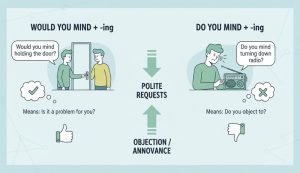
The phrases “would you mind” and “do you mind” are used to make polite requests. The phrase “would you mind” is used to politely request someone to perform an action or allow something to happen. It softens the directness of a command, showing consideration for the other person’s feelings.
Similarly, “will you mind” is less common but can be understood in context as asking if someone will feel bothered by a future action. While “would you mind” emphasizes hypothetical politeness, “will you mind” focuses on the potential emotional impact of the action on the listener.
They are designed to soften the directness of a command or instruction, making the request more considerate of the other person’s willingness and ability to comply.
Classification and Function
“Would you mind” and “do you mind” are classified as interrogative structures used for making polite requests. They function as a way to ask permission or seek cooperation from someone without imposing a demand.
Contexts of Use
These phrases are commonly used in various contexts, including:
- Formal settings (e.g., business meetings, professional emails)
- Informal settings (e.g., asking a friend for a favor)
- Everyday conversations (e.g., requesting assistance from a stranger)
The choice between “would you mind” and “do you mind” often depends on the level of formality and the specific nuance you want to convey. “Would you mind” is generally considered more polite and formal than “do you mind.”
Structural Breakdown
Understanding the structure of these phrases is crucial for using them correctly. Both “would you mind” and “do you mind” follow specific grammatical patterns.
“Would You Mind” Structure
The basic structure of “would you mind” is:
Would you mind + Verb-ing + (object/complement)?
Alternatively:
Would you mind + if + I/we + past tense verb…?
Example:
- Would you mind closing the window?
- Would you mind if I sat here?
“Do You Mind” Structure
The basic structure of “do you mind” is:
Do you mind + Verb-ing + (object/complement)?
Alternatively:
Do you mind + if + I/we + present tense verb…?
Example:
- Do you mind opening the door?
- Do you mind if I use your phone?
Key Differences in Structure
The main structural difference lies in the auxiliary verb used: “would” for a more polite and hypothetical request, and “do” for a more direct, though still polite, request.
When comparing “do you mind” and “would you mind,” the key distinction lies in formality and politeness. “Would you mind” is generally more formal and considerate, making it ideal for professional or less familiar interactions. “Do you mind,” while still polite, is more casual and suitable for friends or informal situations. It’s important to note that using “do you mind do you mind” repetitively is grammatically unnecessary; one correct usage suffices to convey politeness without redundancy.
The tense used after “if” also differs, with past tense verbs used after “would you mind if” and present tense verbs used after “do you mind if”.
Types and Categories of Requests
“Would you mind” and “do you mind” can be used for various types of requests, each requiring a slightly different approach.
Requests for Action
These requests involve asking someone to perform a specific action.
Examples:
- Would you mind helping me with this task?
- Do you mind turning down the volume?
Requests for Permission
These requests involve asking for permission to do something.
Examples:
- Would you mind if I borrowed your pen?
- Do you mind if I sit here?
Requests for Information
While less common, these phrases can also be used to politely request information.
Examples:
- Would you mind telling me the time?
- Do you mind explaining this concept again?
Responding to Requests
Understanding how to respond to these requests is just as important as knowing how to make them. Here are common responses:
- Affirmative (Granting the request): “No, I don’t mind at all,” “Not at all,” “Of course not,” “Please do,” “Go ahead.”
- Negative (Denying the request): “I’m sorry, but I do mind,” “Yes, I do mind,” “I’d rather you didn’t.”
It’s crucial to be clear and polite in your response, regardless of whether you grant or deny the request.
Examples of “Would You Mind” and “Do You Mind”
The following tables provide extensive examples of “would you mind” and “do you mind” used in various contexts.
Table 1: “Would You Mind” Examples
This table illustrates how “would you mind” is used to make polite requests in different situations. Notice the use of the gerund (verb-ing) and the “if” clause.
| Request | Context |
|---|---|
| Would you mind closing the window? | In a chilly office. |
| Would you mind turning off the lights when you leave? | Leaving a room. |
| Would you mind helping me carry these boxes? | Struggling with heavy items. |
| Would you mind moving your car? | Car is blocking the driveway. |
| Would you mind speaking more slowly? | Struggling to understand someone. |
| Would you mind repeating that? | When you didn’t hear something. |
| Would you mind lending me your pen? | Needing a pen urgently. |
| Would you mind waiting a moment? | Asking someone to be patient. |
| Would you mind if I used your phone? | Needing to make an urgent call. |
| Would you mind if I sat here? | Asking to occupy a seat. |
| Would you mind if I opened the door? | Feeling warm in a room. |
| Would you mind if I joined you? | Wanting to join a group. |
| Would you mind if I left early? | Having to leave a meeting. |
| Would you mind if I brought a guest? | Planning to bring someone along. |
| Would you mind if I asked you a question? | Wanting to clarify something. |
| Would you mind holding this for me? | Needing a free hand. |
| Would you mind watching my bag? | Stepping away for a moment. |
| Would you mind keeping an eye on the kids? | Needing a break from parenting. |
| Would you mind checking my work? | Seeking feedback on a task. |
| Would you mind giving me a ride? | Needing transportation. |
| Would you mind passing the salt? | At the dinner table. |
| Would you mind clearing the table? | After a meal. |
| Would you mind doing the dishes? | Assigning chores. |
| Would you mind walking the dog? | Asking for help with pet care. |
| Would you mind watering the plants? | Ensuring plant care. |
Table 2: “Do You Mind” Examples
This table provides examples of “do you mind” used in various scenarios. Note the subtle difference in formality compared to “would you mind.”
| Request | Context |
|---|---|
| Do you mind closing the window? | In a slightly less formal office setting. |
| Do you mind turning down the music? | The music is too loud. |
| Do you mind helping me with this? | Asking for assistance with a problem. |
| Do you mind moving over a bit? | Needing more space. |
| Do you mind speaking up? | Having difficulty hearing someone. |
| Do you mind repeating your name? | For clarification. |
| Do you mind lending me a dollar? | Short on cash. |
| Do you mind waiting five minutes? | Asking for a short delay. |
| Do you mind if I use your computer? | Needing to access a computer quickly. |
| Do you mind if I take this seat? | Asking to sit down. |
| Do you mind if I open another beer? | Asking for permission at a party. |
| Do you mind if I invite my friend? | Planning to add to a guest list. |
| Do you mind if I leave early today? | Needing to leave work. |
| Do you mind if I take a break? | Needing a rest. |
| Do you mind if I ask a personal question? | Proceeding with caution. |
| Do you mind holding this bag for me? | Shopping situation. |
| Do you mind watching my drink? | Stepping away at a bar. |
| Do you mind checking on my cat later? | Asking for a favor while away. |
| Do you mind proofreading this email? | Asking for a quick review. |
| Do you mind driving me home? | Needing a ride after an event. |
| Do you mind passing me the ketchup? | At a casual meal. |
| Do you mind clearing your plate? | After eating. |
| Do you mind loading the dishwasher? | Sharing kitchen tasks. |
| Do you mind feeding the fish? | Daily pet care task. |
| Do you mind sweeping the floor? | Asking for help with cleaning. |
Table 3: Responding to “Would You Mind” and “Do You Mind”
This table outlines appropriate responses to requests made using “would you mind” and “do you mind,” both affirmative and negative.
| Request | Affirmative Response | Negative Response |
|---|---|---|
| Would you mind closing the window? | No, I don’t mind at all. | I’m sorry, but I do mind. I’m cold. |
| Do you mind turning down the music? | Not at all. Let me do it. | Yes, I do mind. I’m enjoying it. |
| Would you mind helping me with this? | Of course not. What do you need? | I’m afraid I can’t right now. I’m busy. |
| Do you mind moving over a bit? | Sure, no problem. | Actually, yes, I do mind. I need the space. |
| Would you mind speaking up? | Certainly. Is this better? | I’m sorry, I have a sore throat. |
| Do you mind if I use your computer? | Go ahead. The password is… | I’d rather you didn’t. I’m using it. |
| Would you mind if I took this seat? | Please do. It’s free. | I’m waiting for someone. |
| Do you mind if I leave early today? | That’s fine. See you tomorrow. | Yes, I do mind. We need you here. |
| Would you mind holding this bag for me? | No problem. I can do that. | I’m sorry, I can’t. I have to leave. |
| Do you mind watching my drink? | Sure, I’ll keep an eye on it. | I’m about to go. |
| Would you mind if I opened the door? | Not at all, please do. | I’d prefer you didn’t, it’s quite drafty. |
| Do you mind if I invite my friend? | Of course, the more the merrier! | I’m sorry, but I’d prefer if it was just us. |
| Would you mind checking on my cat later? | Sure, I’d be happy to! | I’m allergic, so I can’t. |
| Do you mind proofreading this email? | Not a problem, send it over. | I’m really swamped right now. |
| Would you mind giving me a ride? | Of course, where to? | I’m headed in the opposite direction. |
Table 4: Comparing “Would You Mind” and “Do You Mind”
This table summarizes the key distinctions between “would you mind” and “do you mind” to help you choose the appropriate phrase.
| Feature | Would You Mind | Do You Mind |
|---|---|---|
| Formality | More formal and polite | Less formal, still polite |
| Auxiliary Verb | Would | Do |
| Tense after “if” | Past tense (e.g., if I sat) | Present tense (e.g., if I sit) |
| Typical Use | Asking a stranger, making a request in a professional setting | Asking a friend, making a casual request |
| Example | Would you mind closing the window? | Do you mind closing the window? |
Usage Rules and Guidelines
To use “would you mind” and “do you mind” correctly, it’s important to follow specific usage rules and guidelines.
Rule 1: Correct Verb Form
Always use the gerund (verb-ing) after “would you mind” and “do you mind” when directly asking someone to do something.
A common mistake among learners is saying “Do you mind to come?” instead of the correct gerund form. The proper phrasing is “Do you mind coming?” or, if using “would you mind,” “Would you mind coming?” Using the base verb form after “do you mind” is incorrect and can sound unnatural, so focusing on verb-ing forms ensures grammatical accuracy while maintaining politeness.
Correct: Would you mind closing the door?
Incorrect: Would you mind close the door?
Rule 2: Using “If” Clauses
When using “if” clauses, remember the correct tense:
- “Would you mind if I/we + past tense verb…?”
- “Do you mind if I/we + present tense verb…?”
Correct: Would you mind if I sat here?
Correct: Do you mind if I sit here?
Incorrect: Would you mind if I sit here?
Incorrect: Do you mind if I sat here?
Rule 3: Responding Appropriately
A seemingly counterintuitive aspect of responding to these requests is that a “no” answer actually grants the request, while a “yes” answer denies it. This is because you are answering whether you mind doing something, not whether you will do it.
Affirmative Responses:
- “No, I don’t mind.”
- “Not at all.”
- “Of course not.”
- “Go ahead.”
- “Please do.”
Negative Responses:
- “Yes, I do mind.”
- “I’m sorry, but I do mind.”
- “I’d rather you didn’t.”
Rule 4: Level of Formality
Choose “would you mind” for more formal situations and “do you mind” for less formal ones.
Rule 5: Polite Intonation
Always use a polite and respectful tone of voice when making these requests, regardless of the specific phrase used.
Common Mistakes to Avoid
Several common mistakes can occur when using “would you mind” and “do you mind.” Being aware of these pitfalls can help you avoid them.
Mistake 1: Incorrect Verb Form
Using the base form of the verb instead of the gerund (-ing form) is a common error.
Incorrect: Would you mind close the window?
Correct: Would you mind closing the window?
Mistake 2: Wrong Tense in “If” Clauses
Using the wrong tense after “if” can lead to confusion.
Incorrect: Would you mind if I sit here?
Correct: Would you mind if I sat here?
Incorrect: Do you mind if I sat here?
Correct: Do you mind if I sit here?
Mistake 3: Confusing Affirmative and Negative Responses
The most common mistake is misunderstanding the meaning of “yes” and “no” responses.
Incorrect: “Would you mind closing the window?” “Yes.” (meaning you will close it)
Correct: “Would you mind closing the window?” “No, I don’t mind.” (meaning you will close it)
Correct: “Would you mind closing the window?” “Yes, I do mind.” (meaning you don’t want to close it)
Mistake 4: Using the Wrong Level of Formality
Using “would you mind” in a very casual setting can sound overly formal, while using “do you mind” in a formal setting might seem impolite.
Table 5: Correct vs. Incorrect Examples
This table provides a side-by-side comparison of correct and incorrect usages of “would you mind” and “do you mind.”
| Incorrect | Correct | Explanation |
|---|---|---|
| Would you mind to close the door? | Would you mind closing the door? | Correct gerund form (closing) is used. |
| Do you mind if I sat here? | Do you mind if I sit here? | Correct present tense (sit) is used after “do you mind if.” |
| Would you mind if I sit here? | Would you mind if I sat here? | Correct past tense (sat) is used after “would you mind if.” |
| Would you mind help me? | Would you mind helping me? | Correct gerund form (helping) is used. |
| Do you mind to help me? | Do you mind helping me? | Correct gerund form (helping) is used. |
| Would you mind if I will borrow your pen? | Would you mind if I borrowed your pen? | Correct past tense (borrowed) is used. |
| Do you mind if I will use your phone? | Do you mind if I use your phone? | Correct present tense (use) is used. |
| Would you mind to speak louder? | Would you mind speaking louder? | Correct gerund form (speaking) is used. |
| Do you mind to speak slower? | Do you mind speaking slower? | Correct gerund form (speaking) is used. |
| Would you mind if I am late? | Would you mind if I was late? | Correct past tense (was) is used. |
Practice Exercises
Test your understanding of “would you mind” and “do you mind” with the following exercises.
Exercise 1: Fill in the Blanks
Complete the following sentences with the correct form of “would you mind” or “do you mind.”
| Question | Answer |
|---|---|
| __________ closing the door? It’s cold in here. | Would you mind |
| __________ if I sat next to you? | Do you mind |
| __________ helping me with this heavy bag? | Would you mind |
| __________ if I borrowed your notes? | Would you mind |
| __________ turning off the lights when you leave? | Would you mind |
| __________ if I used your laptop for a moment? | Do you mind |
| __________ speaking a bit louder? | Would you mind |
| __________ if I took a picture? | Do you mind |
| __________ passing me the salt? | Would you mind |
| __________ if I opened the window? | Do you mind |
Exercise 2: Correct the Mistakes
Identify and correct the mistakes in the following sentences.
| Incorrect Sentence | Correct Sentence |
|---|---|
| Would you mind to help me? | Would you mind helping me? |
| Do you mind if I was late? | Do you mind if I am late? |
| Would you mind if I sit here? | Would you mind if I sat here? |
| Do you mind close the window? | Do you mind closing the window? |
| Would you mind speak slowly? | Would you mind speaking slowly? |
| Do you mind if I borrowed your book? | Do you mind if I borrow your book? |
| Would you mind to turn off the TV? | Would you mind turning off the TV? |
| Do you mind if I will come with you? | Do you mind if I come with you? |
| Would you mind if I am using your pen? | Would you mind if I used your pen? |
| Do you mind if I am sitting here? | Do you mind if I sit here? |
Exercise 3: Rewrite the Sentences
Rewrite the following sentences using “would you mind” or “do you mind” to make them more polite.
| Original Sentence | Rewritten Sentence |
|---|---|
| Please close the window. | Would you mind closing the window? |
| Can I sit here? | Do you mind if I sit here? |
| Help me with this. | Would you mind helping me with this? |
| Lend me your pen. | Would you mind lending me your pen? |
| Turn off the lights. | Would you mind turning off the lights? |
| Can I use your phone? | Do you mind if I use your phone? |
| Speak louder. | Would you mind speaking louder? |
| Can I take a picture? | Do you mind if I take a picture? |
| Pass me the salt. | Would you mind passing me the salt? |
| Can I open the window? | Do you mind if I open the window? |
Advanced Topics and Nuances
For advanced learners, exploring more complex aspects of “would you mind” and “do you mind” can further refine their understanding and usage.
Using “Would You Mind” with Negative Requests
You can also use “would you mind” to make negative requests, asking someone not to do something. For example:
- Would you mind not smoking here?
- Would you mind not making so much noise?
Subtle Differences in Politeness
While “would you mind” is generally considered more polite, the context and tone of voice can also influence the perceived level of politeness. In some cases, “do you mind” can be perfectly acceptable, especially among close friends or family members.
Alternatives to “Would You Mind” and “Do You Mind”
Other phrases can be used to make polite requests, depending on the situation:
- Could you…?
- Can you…?
- I was wondering if you could…
- Is it okay if I…?
Table 6: Comparing Alternative Phrases
This table compares “would you mind” and “do you mind” with other polite request phrases, highlighting their nuances and appropriate contexts.
| Phrase | Formality | Typical Use |
|---|---|---|
| Would you mind…? | Very formal | Asking strangers, making requests in professional settings |
| Do you mind…? | Formal | Asking acquaintances, making polite requests |
| Could you…? | Semi-formal | Making requests to colleagues, service staff |
| Can you…? | Informal | Asking friends, family members |
| Is it okay if I…? | Informal | Seeking permission in casual settings |
Frequently Asked Questions
Here are some frequently asked questions about “would you mind” and “do you mind.”
What is the main difference between “would you mind” and “do you mind”?
The main difference is the level of formality. “Would you mind” is generally more formal and polite than “do you mind.” “Would you mind” uses the auxiliary verb “would,” while “do you mind” uses “do.”
How do I respond affirmatively to “Would you mind…?”
An affirmative response means granting the request. Common affirmative responses include “No, I don’t mind,” “Not at all,” “Of course not,” “Go ahead,” and “Please do.”
How do I respond negatively to “Do you mind…?”
A negative response means denying the request. Common negative responses include “Yes, I do mind,” “I’m sorry, but I do mind,” and “I’d rather you didn’t.”
Why is it important to use the gerund (verb-ing) after “would you mind” and “do you mind”?
Using the gerund is grammatically correct and ensures that the phrase functions as a polite request. Without the gerund, the sentence would be grammatically incorrect.
When should I use “would you mind if” instead of “would you mind” + verb-ing?
Use “would you mind if” when you are asking for permission to do something yourself, rather than asking someone else to do something. For example, “Would you mind if I opened the window?”
Is it rude to say “yes” to “Would you mind…?”
It’s not rude, but it’s important to understand that saying “yes” means you do mind and are therefore denying the request. If you intend to grant the request, you should say “no, I don’t mind.”
Can I use “would you mind” and “do you mind” in written communication?
Yes, you can use both phrases in written communication. “Would you mind” is suitable for formal emails, while “do you mind” is appropriate for less formal messages.
Are there any regional differences in the use of these phrases?
While the basic usage is consistent across English-speaking regions, subtle differences in formality and preferred phrasing may exist. Pay attention to how native speakers use these phrases in your specific region.
Conclusion
Mastering the use of “would you mind” and “do you mind” is a valuable skill for anyone learning English. These phrases are essential for making polite requests in various contexts, from formal business settings to casual conversations with friends.
By understanding the structural differences, usage rules, and common mistakes associated with these phrases, you can confidently and correctly incorporate them into your everyday communication. Remember to consider the level of formality and to pay attention to your tone of voice to ensure your requests are perceived as polite and respectful.
Continue practicing with the exercises provided and be mindful of how native speakers use these phrases in real-life situations. With consistent effort, you’ll be able to navigate the nuances of “would you mind” and “do you mind” with ease, enhancing your overall fluency and communication skills in English.